
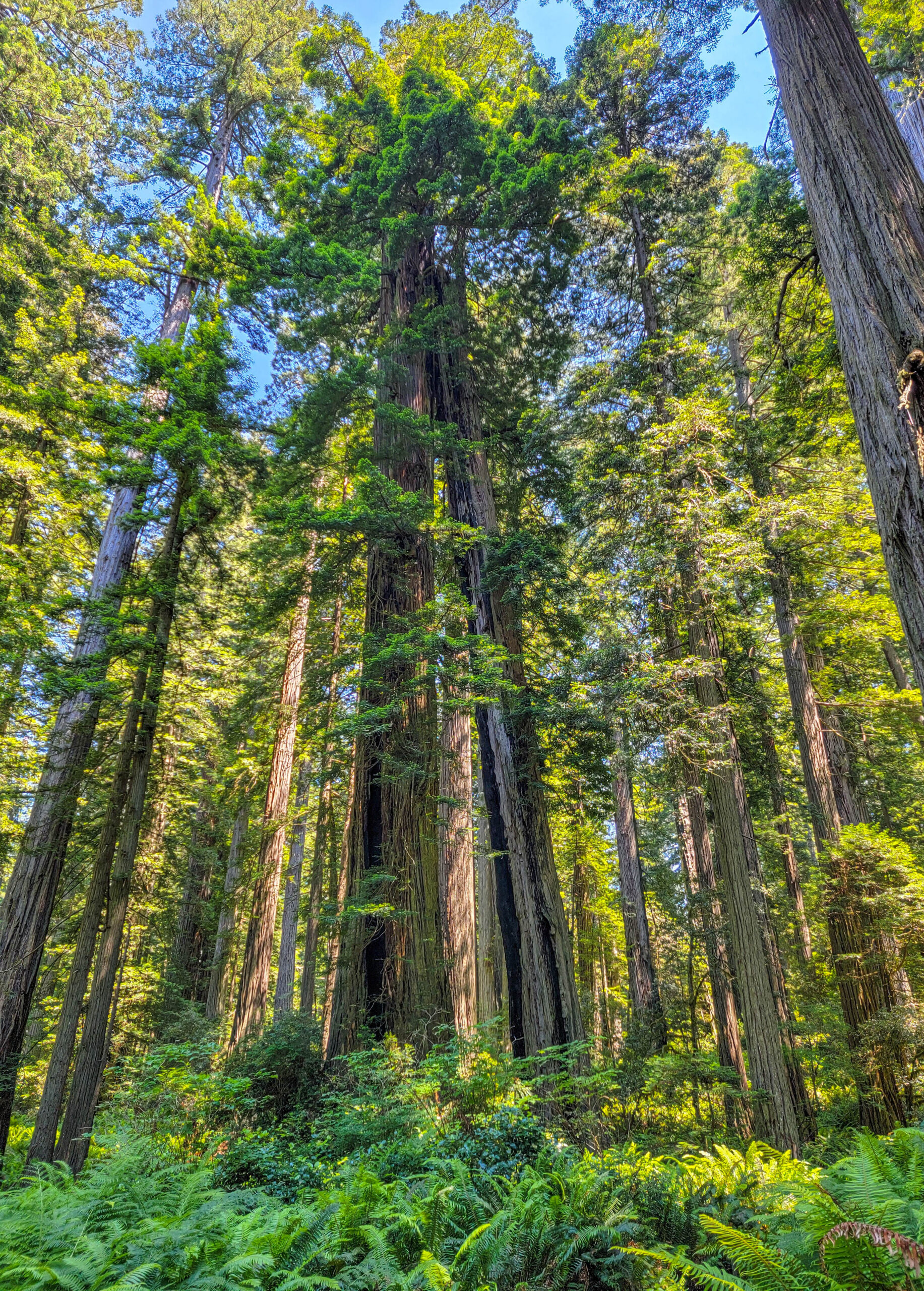

The coast California redwoods parks of Northern California run about 150 miles (240 km) along Highway 101, from Crescent City near the Oregon border south to Garberville. This guide covers that whole corridor: the four parks of Redwood National and State Parks in the north, and Humboldt Redwoods State Park — a separate park with its own famous drive — about 100 miles further south.
California Coast redwoods are the tallest trees on earth, routinely exceeding 350 feet (107 m). They once covered around two million acres of this coast. Logging took roughly 95% of the old growth in a little over a century, and what’s left is almost entirely inside these parks.
Two things confuse almost everyone planning this trip. First, “Redwood National Park” on its own barely exists as a visitor destination — it’s jointly managed with three state parks as a single unit. Second, the Avenue of the Giants is not in that unit. It’s in Humboldt Redwoods State Park, a separate California state park a hundred miles south. Both are worth your time; they just aren’t the same trip.
A note on this guide. The firsthand detail here covers the southern half of the corridor — the Orick area, Humboldt Bay, and the Avenue of the Giants. We didn’t get up to Jedediah Smith or Del Norte Coast, so those two sections are written from official sources and flagged as such.
What “Redwood National and State Parks” Actually Means
Four parks, managed together since 1994:
- Redwood National Park — established 1968
- Prairie Creek Redwoods State Park — 1920s
- Del Norte Coast Redwoods State Park — 1920s
- Jedediah Smith Redwoods State Park — 1920s
The state parks came first. California created them in the 1920s, largely through the Save-the-Redwoods League, to protect the best remaining groves. Congress added the national park around them in 1968, and in 1994 the two agencies agreed to run all four as one unit.
Together they hold 37 miles (60 km) of coastline alongside the old-growth groves. The United Nations designated the area a World Heritage Site in 1980.
Humboldt Redwoods State Park is not part of this, despite being the largest redwood state park and holding the single most famous redwood drive in the world.
Fees, Passes, and Permits
Redwood National and State Parks has no entrance fee. No vehicle pass, no gate, nothing. This is unusual for a national park and it surprises people.
What does cost money or require planning:
- Fern Canyon and Gold Bluffs Beach — reservation required May 15 to Sept 15, plus a $12 day-use fee, cash or check only
- Tall Trees Grove — free permit required year-round, limited to 50 parties per day, online only
- State park campgrounds — standard California State Parks camping fees
- Humboldt Redwoods — no entrance fee; the Williams Grove day-use area charges $8
So the two most talked-about destinations in the parks are the two that need advance planning. Sort those before you sort anything else — we visited in 2021, before the Fern Canyon reservation system existed, and the difference between then and now is entirely about booking rather than about the place itself.
Getting Around
Highway 101 is the spine. Everything in this guide is on it or a short turn off it.
Distances along the corridor:
- Crescent City to Orick — about 45 minutes
- Orick to Eureka — about 45 minutes
- Eureka to the Avenue of the Giants — about 45 minutes
- Crescent City to Garberville, end to end — roughly 3 hours without stops
Give it three days minimum. Two if you’re only doing the northern parks. One day gets you a couple of groves and a lot of driving.
Cell service is unreliable across most of the corridor and absent in the parks. Download maps.
The Parks, North to South
(1) Jedediah Smith Redwoods State Park – Crescent City
The northernmost park, on the Smith River — the last major undammed river in California. Howland Hill Road runs about 10 miles (16 km) of mostly unpaved surface directly through old growth between Crescent City and Hiouchi, and it’s widely rated the best redwood drive in the northern parks. Not suitable for RVs or trailers.
Stout Memorial Grove is the signature walk here, and unlike Lady Bird Johnson Grove it’s genuinely accessible.
We didn’t reach this park — details are from official sources.
(2) Del Norte Coast Redwoods State Park
Between Crescent City and Klamath, where old-growth redwood runs right down to the ocean. Mill Creek Campground is the main developed area. The Damnation Creek Trail is the well-known hike, steep and often foggy.
Also not visited on our trip.
(3) Klamath and the Coastal Drive
The Klamath River meets the ocean here. The Coastal Drive runs about 8 miles (13 km) south from the river mouth toward Prairie Creek — narrow, partly unpaved, with ocean overlooks and remnants of a World War II radar station disguised as a farmhouse.
(4) Prairie Creek Redwoods State Park – Orick
The heart of the northern parks and where most visitors spend their time.
The Newton B. Drury Scenic Parkway runs 10 miles (16 km) of old parallel highway through continuous old growth — the northern equivalent of the Avenue of the Giants, and free of trucks. Big Tree Wayside, the Prairie Creek Visitor Center, and Elk Prairie are all on it.
Roosevelt elk are the other draw. Elk Prairie and Gold Bluffs Beach both hold resident herds, and they’re genuinely large animals — give them room, especially bulls in the autumn rut.
Fern Canyon is here, reached by the unpaved Davison Road: a mile-long loop through a gorge with 50 to 80-foot walls covered end to end in ferns. It needs a summer reservation and you will get wet feet.

Fern-covered walls of Fern Canyon along Home Creek
Read the full trail guide: Fern Canyon
(5) Redwood National Park – Bald Hills Road
Two of the corridor’s best walks sit off Bald Hills Road, which climbs east from Highway 101 just north of Orick.
Wide trail through old-growth redwood in Lady Bird Johnson Grove
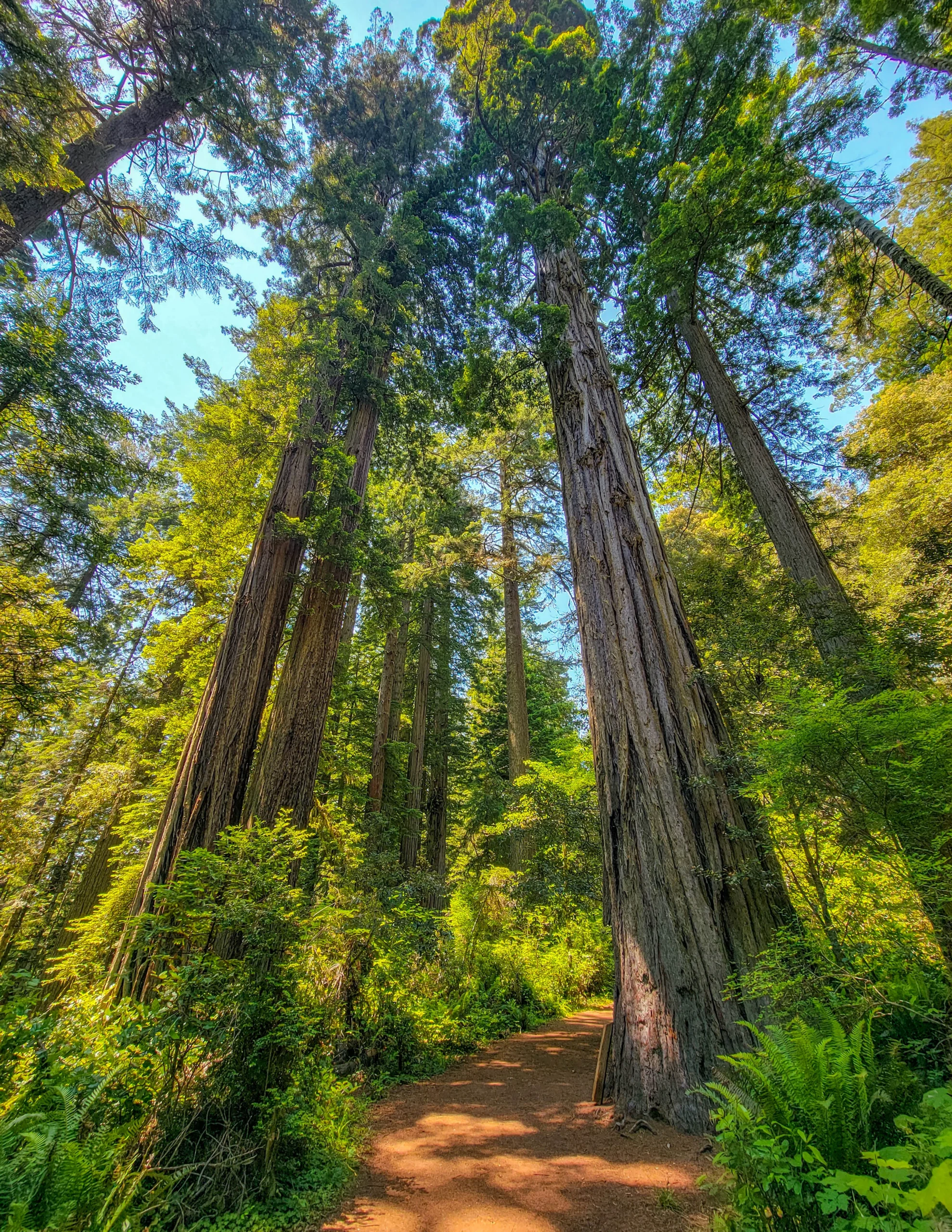
Lady Bird Johnson Grove is a 1.5-mile (2.4 km) loop at around 1,000 feet, dedicated by President Nixon in 1969. Free, no permit, and the best introduction to old growth in the parks — but despite its reputation as the easy one, it is not wheelchair accessible, because the footbridge approach exceeds the allowable slope.
A hiker for scale against the base of a massive coast redwood
Read the full trail guide: Lady Bird Johnson Grove
Upturned root plate of a fallen redwood
Tall Trees Grove is the more serious hike: 4.5 miles (7.2 km) round trip with 1,600 feet (487 m) of total elevation change, down to an alluvial flat on Redwood Creek where trees exceed 350 feet. It needs a free permit, capped at 50 parties a day, which comes with a gate code for a locked access road.
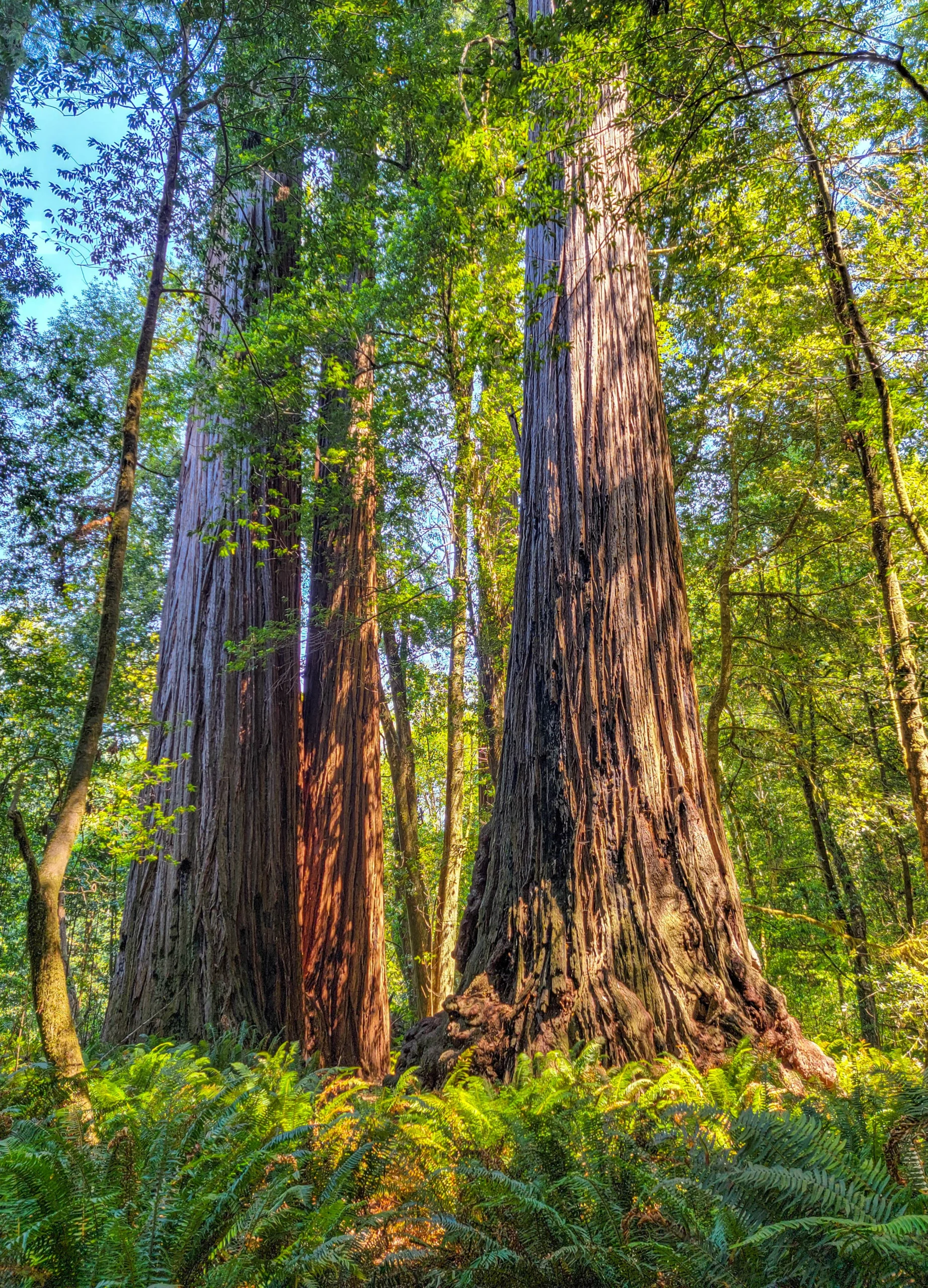
Tall redwoods above ferns on the Redwood Creek flat in Tall Trees Grove, California
Read the full trail guide: Tall Trees Grove
Both trailheads are on the same road, so you can pair the easy upland loop with the strenuous valley hike in one outing if your legs are willing. We split them across two days and did Fern Canyon and Lady Bird together instead, which made for a comfortable half day from Orick.
(6) Eureka and Humboldt Bay
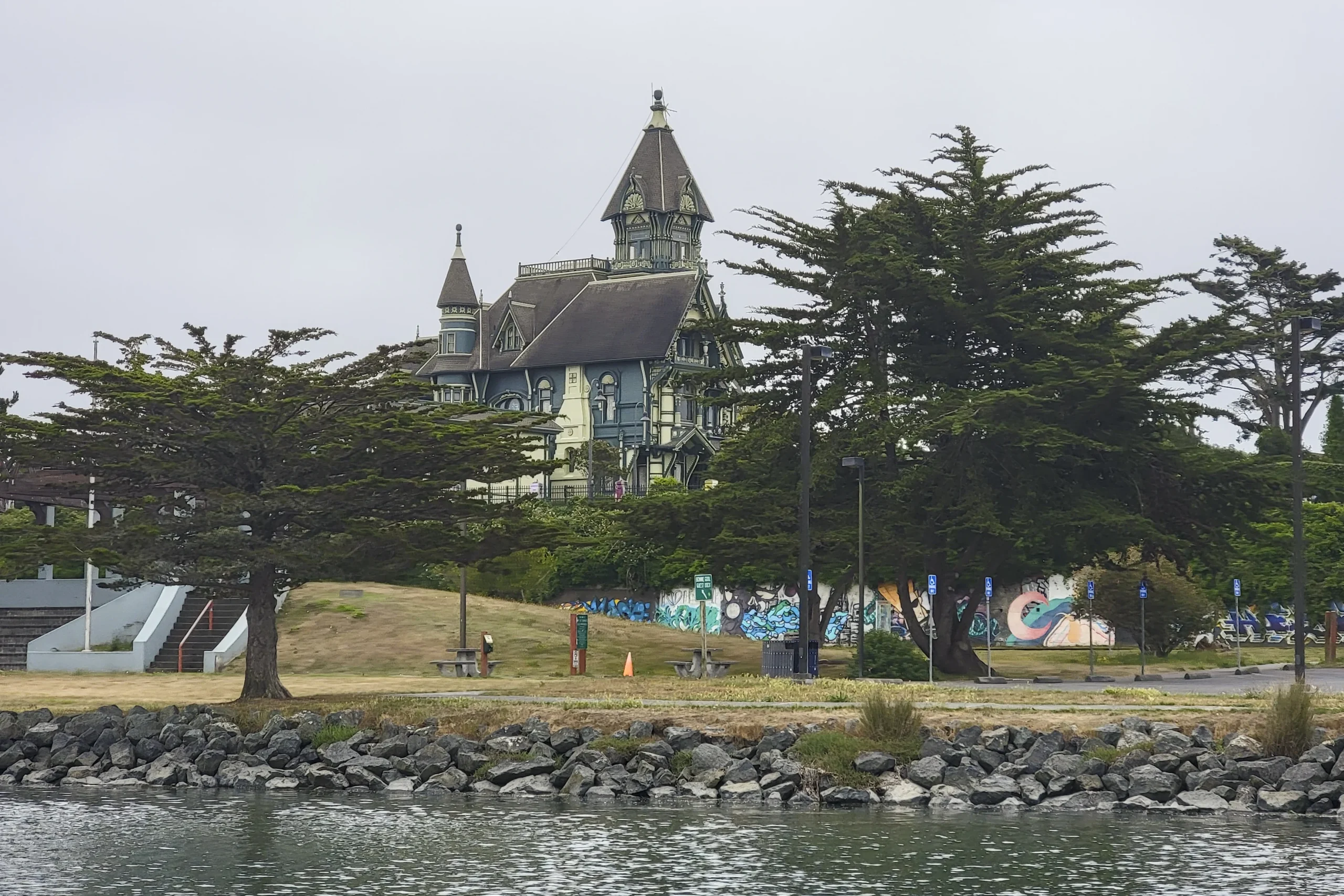
The Carson Mansion in Eureka seen from Humboldt Bay
The practical base for the whole corridor, and the one place with a real range of lodging, food, and services. Eureka got rich on redwood, and the Victorian architecture is the evidence — the Carson Mansion is the most photographed Victorian in the country, though it’s been a private club since 1950 and you can’t go inside.
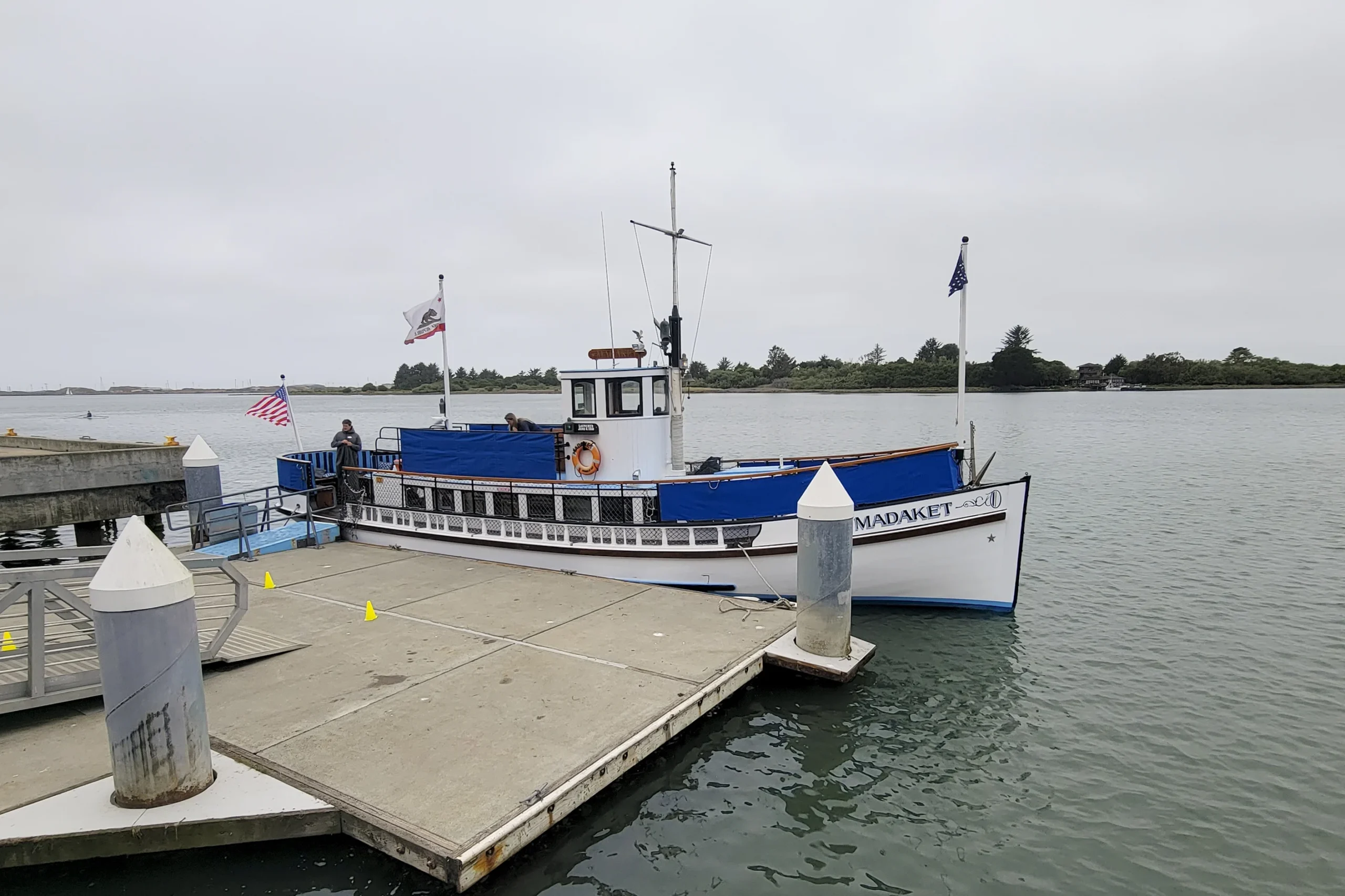
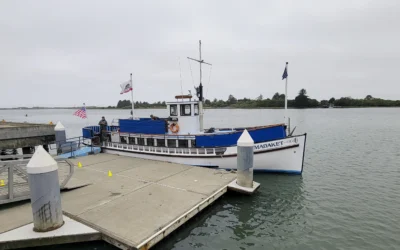
The historic ferry Madaket tied up at the C Street dock in Old Town Eureka, California
The Madaket, a 1910 ferry and the oldest passenger vessel in continuous service in the United States, runs 75-minute narrated harbor cruises from the foot of C Street. It covers the timber history, the Victorians from the water, and Tuluwat Island — Wiyot ancestral land, site of an 1860 massacre, more than 200 acres of which the City of Eureka returned to the tribe in 2019.
Read the full guide: Madaket Harbor Cruise
(7) The Lost Coast Scenic Drive – Ferndale to Humboldt Redwoods
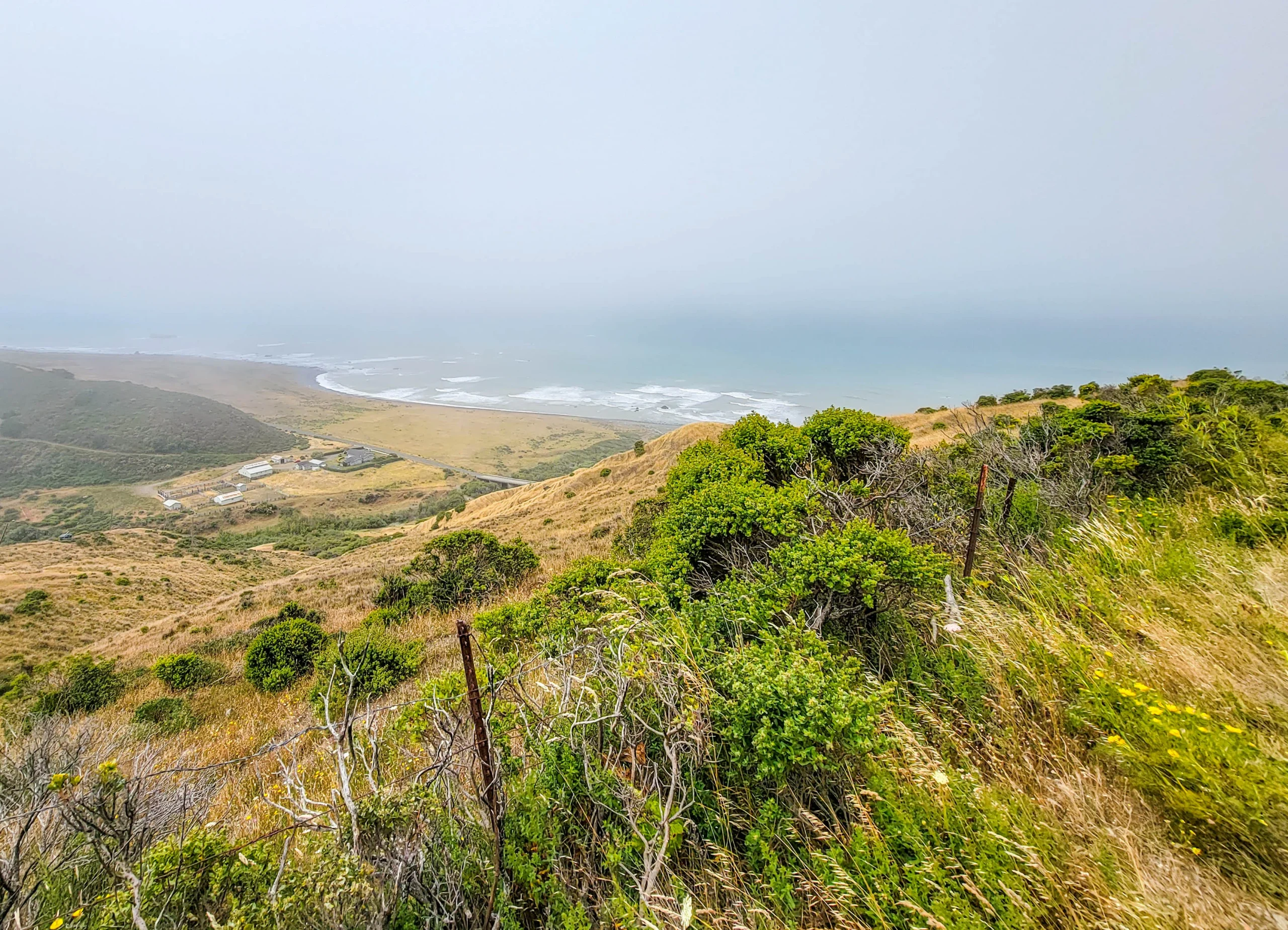
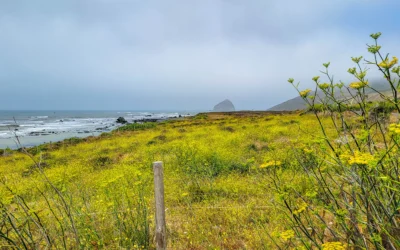
Looking down from Mattole Road toward the Lost Coast shoreline
A four-hour round trip on Mattole Road from the Victorian town of Ferndale, over the ridge to the ocean at Cape Mendocino, then inland through Petrolia and Honeydew. It’s the closest you can get to California’s only coastal wilderness without a backpack.
It also connects directly to the Avenue of the Giants, which makes the two into one long, excellent day. Motor homes and trailers are not advised.
Read the full guide: Lost Coast Scenic Drive
(8) Humboldt Redwoods State Park and the Avenue of the Giants

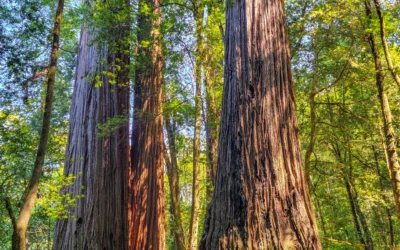
Avenue of the Giants scenic drive winding between old-growth coast redwoods in Humboldt Redwoods State Park, California
A separate park, about 100 miles south of the RNSP cluster, and the largest redwood state park in California at more than 53,000 acres (21,400 ha). Roughly 17,000 acres of that is old growth — the largest expanse of ancient redwood forest left anywhere.
The Avenue of the Giants is a 32-mile (51 km) scenic drive on the old Highway 101 alignment, running parallel to the modern freeway. Rockefeller Forest, off Mattole Road, is the largest contiguous old-growth coast redwood forest on earth and the detour most people skip. Of everything in this corridor it’s the one I’d least want to give up.

South Fork of the Eel River seen through summer wildflowers along the Avenue of the Giants
The South Fork of the Eel runs alongside the drive, and in summer it’s swimmable.
Read the full guide: Avenue of the Giants
Best Walks at a Glance
| Trail | Park | Distance | Difficulty |
|---|---|---|---|
| Lady Bird Johnson Grove | Redwood NP | 1.5 mi (2.4 km) | Easy |
| Fern Canyon | Prairie Creek | 1 mi (1.6 km) | Easy, wet |
| Tall Trees Grove | Redwood NP | 4.5 mi (7.2 km) | Moderately strenuous |
| Founders Grove | Humboldt Redwoods | 0.5 mi (0.8 km) | Easy, accessible |
| Rockefeller Loop | Humboldt Redwoods | 0.7 mi (1.1 km) | Easy |
| Stout Memorial Grove | Jedediah Smith | 0.5 mi (0.8 km) | Easy, accessible |
| Drury-Chaney Loop | Humboldt Redwoods | 2.4 mi (3.9 km) | Easy |
| Prairie Creek–Foothill Loop | Prairie Creek | ~4 mi (6.4 km) | Moderate |
Dogs are not permitted on trails in Redwood National and State Parks or on most Humboldt Redwoods trails. This is stricter than many parks and catches people out.
The Best California Redwoods Drives
Five, ranked by how much old growth you get per mile:
- Howland Hill Road, Jedediah Smith — 10 miles, mostly unpaved, no RVs
- Avenue of the Giants, Humboldt Redwoods — 32 miles, paved, the famous one
- Newton B. Drury Scenic Parkway, Prairie Creek — 10 miles, paved, Roosevelt elk
- Mattole Road through Rockefeller Forest, Humboldt Redwoods — the best forest in the corridor
- Coastal Drive, near Klamath — 8 miles, ocean rather than trees
Photography Notes
- Fog and overcast beat sunshine, always. Direct sun through a canopy gap creates a contrast range no sensor holds. A gray, dripping morning is the good version.
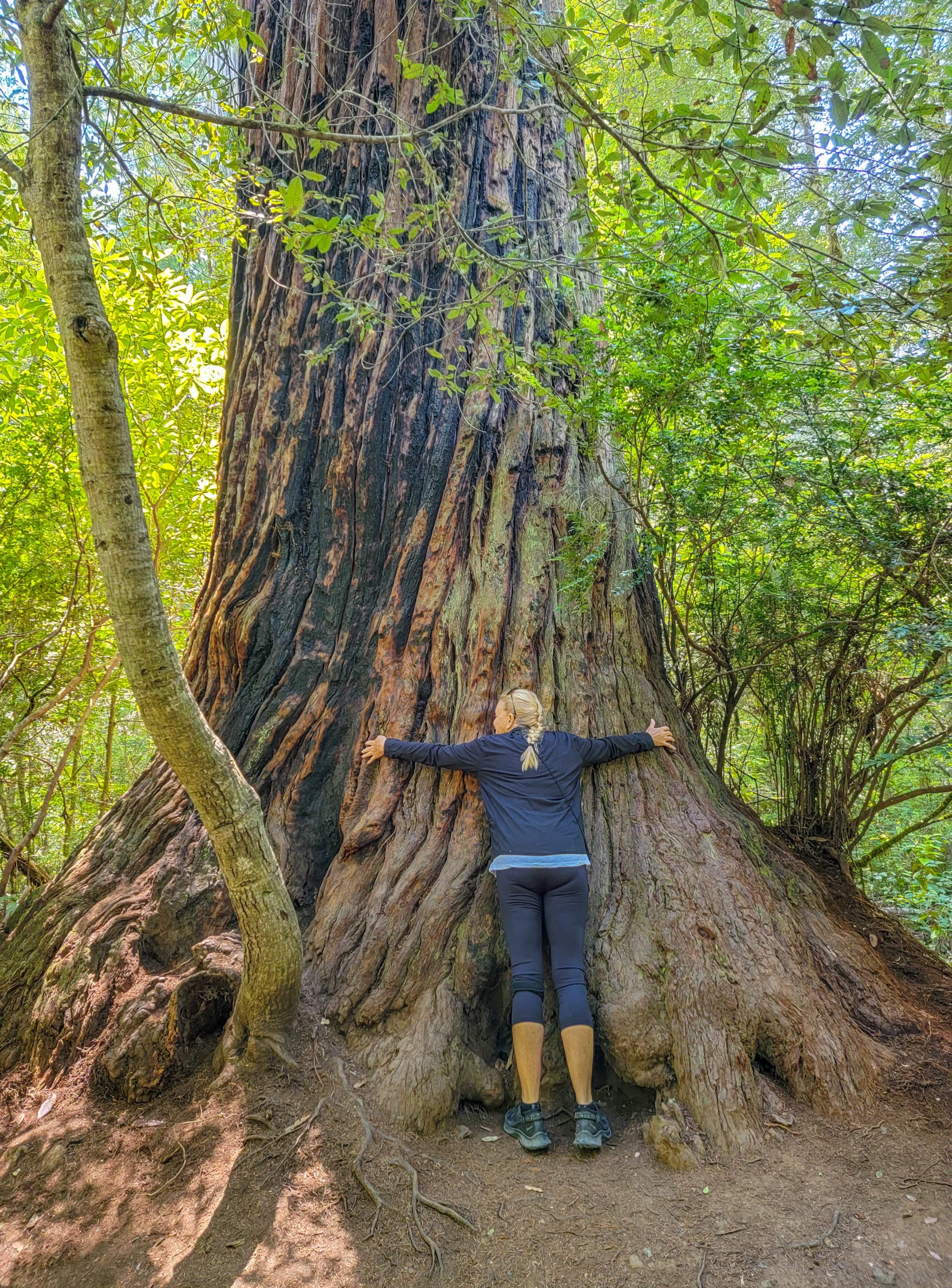
- Include a person. Redwood bark reads the same at any scale — without a human figure a 12-foot trunk looks like a 3-foot one.
- Shoot straight up. Canopy gaps showing crowns converging 300 feet overhead are the frames people remember.
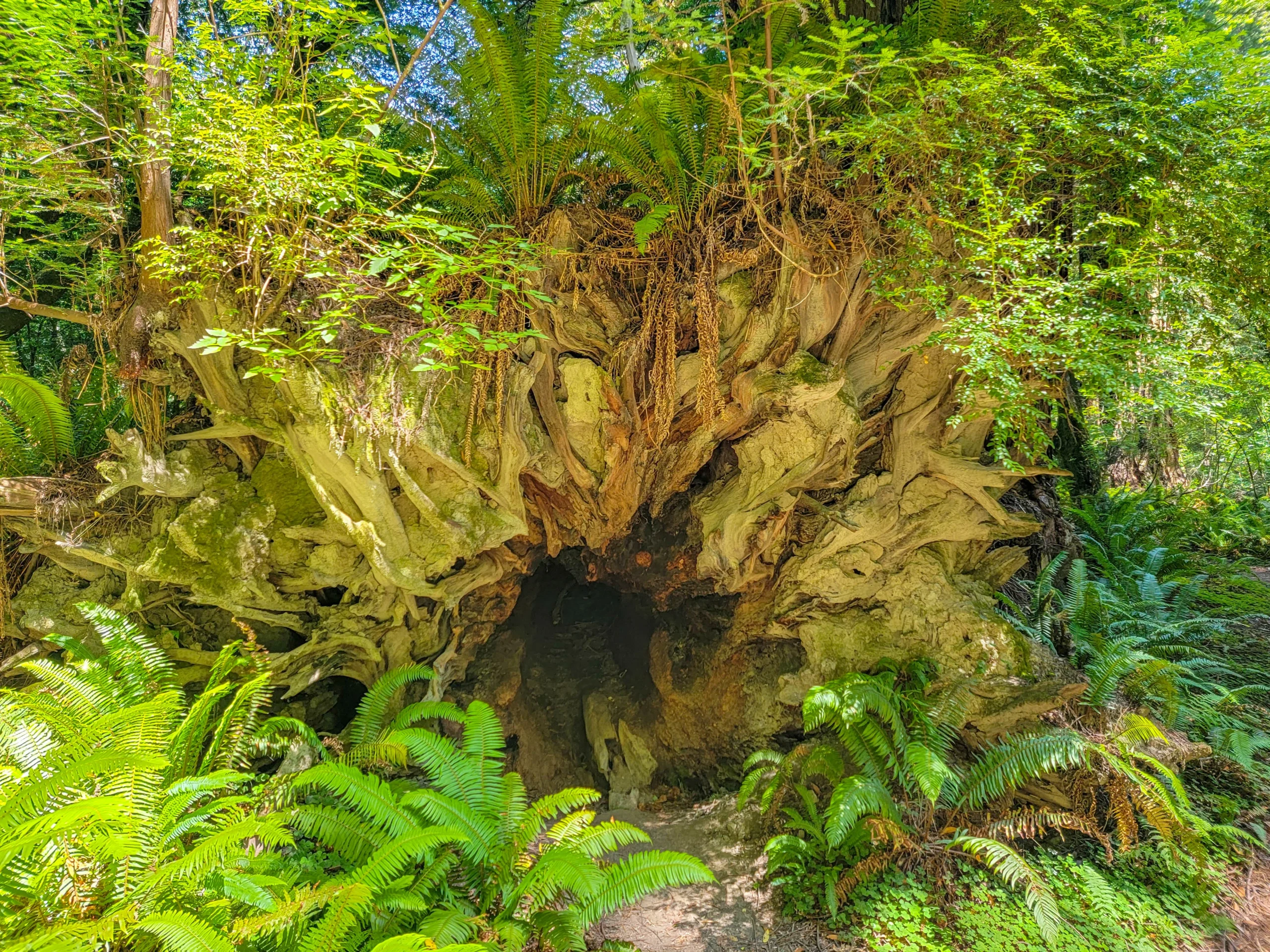
- Root plates beat trunks for conveying size. A fallen redwood’s upended roots stand two stories high and the eye reads it instantly.
- Include the road on the scenic drives. Empty pavement between trunks tells the story better than trees alone.
- Watch white balance. Light filtering through the canopy goes green. Shoot raw.
- The coast is a different problem. Bring a longer lens for Humboldt Bay and the Lost Coast, where subjects are across water or below you.
Where to Base Yourself
- Crescent City — best for Jedediah Smith and Del Norte Coast. Motels, limited dining.
- Klamath — small, central to the northern parks, few services.
- Orick — closest to Fern Canyon, Lady Bird, and Tall Trees. Very limited services; treat it as a trailhead, not a town.
- Trinidad — small coastal town between Orick and Eureka, more appealing than its size suggests.
- Eureka and Arcata — the practical base. Full services, the widest lodging range, and the Victorian district. Most people should stay here.
- Garberville and Miranda — the southern end, for the Avenue of the Giants.
Camping is the better move if you’re equipped. The main options are Jedediah Smith, Mill Creek, Elk Prairie, and Gold Bluffs Beach in the north, and Burlington, Albee Creek, and Hidden Springs in Humboldt Redwoods. Reserve through ReserveCalifornia. All are in bear country.
Know Before You Go
- Fog is the summer default and it’s not a problem — it’s what the trees live on. Coast redwoods take a substantial share of their water directly from fog drip.
- Bring layers. It runs cold and damp under the canopy even in August.
- No dogs on trails.
- Book Fern Canyon and Tall Trees early. They’re the two that will otherwise cost you a day.
- Two roads are explicitly unsuitable for RVs and trailers — Howland Hill and Mattole. Bald Hills and Davison are also poor choices in anything large.
- Watch for elk on the road near Elk Prairie and along Davison Road.
- Stay out of the Hyperion area. The tallest tree in the world is in these parks, is not on any trail, and the area around it has been closed since 2022 with a $5,000 fine and up to six months in jail for going there.
Is It Worth It?
The California redwoods are the least oversold major destination in California. Photographs fail to convey them, which is unusual — most famous landscapes photograph better than they look in person, and this is the reverse. We came in expecting big trees and left thinking the scale is genuinely hard to hold in your head.
The honest planning notes: it’s a long, thin destination and you’ll spend real time driving. The two best-known spots need advance permits. Services are thin outside Eureka. And the weather is gray and wet a lot of the year, which is exactly what the trees require.
Give it three days, base in Eureka, book Fern Canyon and Tall Trees before you arrive, and drive at least two of the scenic routes. If you only have one day, do Lady Bird Johnson Grove and the Newton B. Drury Parkway in the north, or the Avenue of the Giants and Rockefeller Forest in the south — but don’t try to do both ends.
If you have some additional time on your travels, consider visiting Lassen Volcanic National Park. It’s a unique and amazing place, and very close to the California Redwoods. Learn more in our Lassen Volcanic National Park Guide here.
For current conditions, permits, and closures, visit the National Park Service page for Redwood National Parks and California State Parks for Humboldt Redwoods.
0 Comments