Fern Canyon Trail Facts
– Distance: 1 mile (1.6 km) lollipop loop; sources commonly list 1.1 miles (1.8 km)
– Elevation gain: About 150 feet (46 m)
– Time: 30 minutes minimum; budget 1 to 2 hours if you’re shooting photos
– Difficulty: Easy in distance, moderate in footing — creek crossings and a short stair climb
– Trail surface: Gravel creek bed, water, wooden steps, and forest duff on the upper loop
– Trailhead: Fern Canyon Trailhead, Gold Bluffs Beach Day-Use Area
– Accessibility: Not wheelchair accessible
– Dogs: Not permitted on the trail; allowed on Gold Bluffs Beach on a 6-foot leash
Shorter option: Walk a quarter mile (0.4 km) into the canyon and turn around. You see the best of the fern walls in that first stretch, and you skip the stairs entirely.
Permits and Fees — Read This First
A reservation is required from May 15 to September 15 to visit the Fern Canyon Trailhead or the Gold Bluffs Beach Day-Use Area. This took effect in May 2022. Reservations are free, released on a first-come first-served basis, and can be booked up until 11:59 p.m. Pacific the day before — but book well ahead, because summer slots go fast.
– Online reservation: free, one per vehicle. Multiple vehicles need multiple reservations.
– Day-use fee: $12, collected at the Gold Bluffs Beach kiosk. Cash or check only — no cards.
– Accepted passes: America the Beautiful, California State Park Annual Pass or Poppy Pass, or a current Gold Bluffs Beach or Elk Prairie campground reservation. Campground reservation holders don’t need a separate permit.
– September 16 to May 14: No reservation required.
Book your permit through the National Park Service at
Fern Canyon Permits. For permit questions, contact Redwood National and State Parks at (707) 464-6101 or Redw_Permits@nps.gov.
Do not plan to park on Davison Road without a permit. Roadside parking is prohibited and vehicles are cited.
No reservations left? Hike in on the James Irvine Trail from the Prairie Creek Redwoods State Park Visitor Center. It’s about 10 miles (16 km) round trip and 6 to 8 hours, and it requires no permit. That’s a full day, but it’s a genuinely good trail through old-growth redwood, and it gets you into the canyon from the other end.
Getting There — Davison Road
Budget 30 minutes or more from Highway 101 for a drive that looks short on a map.
Davison Road is 7.5 miles (12 km) of winding dirt road off Highway 101 north of Orick. It’s recommended for passenger vehicles only, with hard limits of 8 feet wide and 24 feet long. Trailers and large RVs are prohibited outright.
Two stream crossings sit 1.3 miles (2.1 km) before the trailhead, and you drive through both of them. There are no bridges. High-clearance four-wheel drive is recommended, especially in early summer when flows are still up. If your vehicle can’t make the crossings, you can park and walk the extra 1.3 miles each way — worth knowing in advance rather than discovering at the water’s edge.
At the trailhead you’ll find pit toilets, picnic tables, trash cans, and beach access. There is no potable water and no concessions. Bring everything you need.
Cell reception is not guaranteed anywhere in this part of the park
.
Hiking Fern Canyon
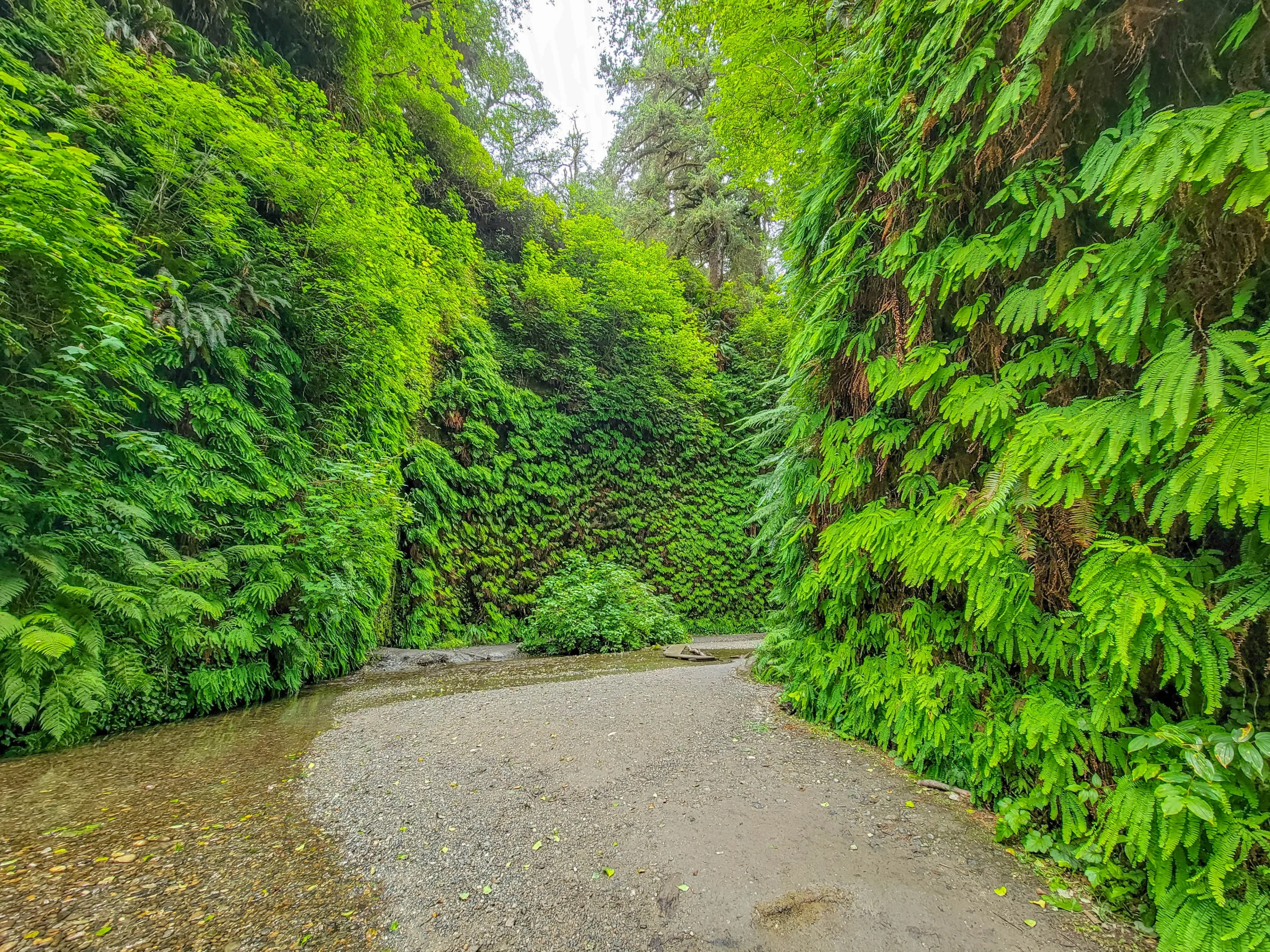
The trail drops into the canyon almost immediately, and the walls close in within the first hundred yards. There is no constructed trail inside the canyon — you walk the gravel creek bed, and you cross Home Creek repeatedly, often on rocks, fallen logs, or temporary board bridges.

Fern Canyon walls with a fallen log spanning Home Creek
Wear water shoes or waterproof boots. The park installs seasonal footbridges roughly June through September, and even with them in place most people get wet feet. Outside those months there are no bridges at all. I’d rather walk in shoes I’ve accepted will get soaked than spend the whole canyon trying to rock-hop and watching my feet instead of the walls.

Fallen logs across the gravel creek bed inside Fern Canyon
Downed trees lie across the canyon at intervals, some of them spanning wall to wall well overhead. They aren’t obstacles so much as scale markers — it’s hard to read the height of the walls until something horizontal crosses them.
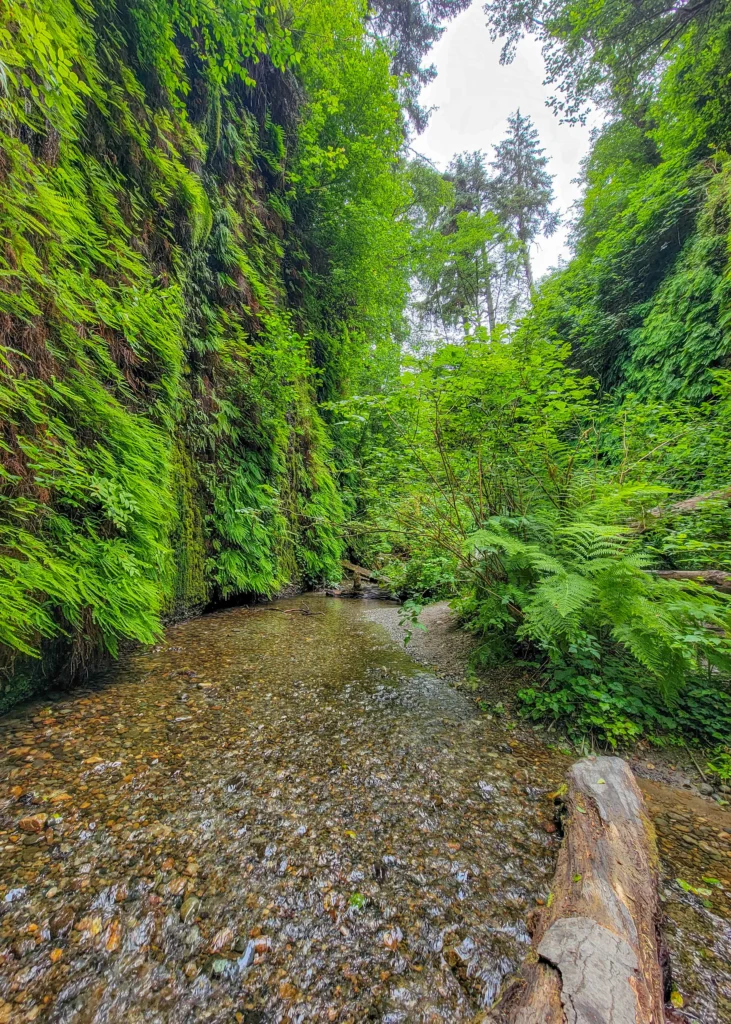
Narrow section of Fern Canyon with fern-covered wall and shallow creek
The narrowest stretch is the best of it. The walls run close together, the ferns hang in continuous sheets, and the light that reaches the floor has gone green by the time it gets there. This is the section that shows up in every photograph of the place, and for once the photographs undersell it.
Fern Canyon appeared in The Lost World: Jurassic Park in 1997, which explains a fair share of its visitors. It holds up entirely on its own merits, film credit or not.
Climbing Out
Near the head of the canyon, a set of wooden steps climbs the wall and puts you on the upper loop.

Wooden steps beside Home Creek at the head of Fern Canyon
This is the only real elevation on the hike, and it’s over quickly. The steps are often wet and can be slick.

Wooden steps climbing out of Fern Canyon through ferns and elderberry
The Upper Loop
The return leg is a completely different forest, and it’s the part most people rush. The canyon opens into tall Sitka spruce with a boardwalk and footbridges running through it.

Wooden footbridge on the James Irvine Trail through Sitka spruce forest

Tall Sitka spruce forest above Fern Canyon in Prairie Creek Redwoods State Park
The trees up here are enormous, moss covers everything, and after the enclosed green of the canyon the sudden vertical space is a real contrast.

Forest trail through mossy spruce in Prairie Creek Redwoods State Park

Trail passing between two moss-covered spruce trunks on the Fern Canyon loop
A boardwalk section crosses wet ground thick with skunk cabbage.

Boardwalk through skunk cabbage on the upper Fern Canyon loop
The loop closes with a stretch along the canyon rim, looking down at the creek bed you just walked in on.

Looking down into Fern Canyon from the rim trail with hikers on the creek bed below
That view down is the one that finally gives you the proportions — the people on the gravel below are tiny, and the walls read at full height for the first time.
Photography Notes
– Overcast is ideal, and this coast delivers it. Fog and flat light keep the contrast manageable. On a sunny day the canyon floor goes black while the rim blows out.
– Bring a lens cloth. The canyon is humid, water drips off the walls, and lenses fog.
– Shoot the narrow section from creek level, looking up-canyon, to get both walls converging.
– Include a person or a fallen log for scale. Fern walls photograph as texture without a reference object.
– The upper loop is worth its own frames, not just a walk back. The spruce and boardwalk sections are photogenic in a completely different register from the canyon.
Know Before You Go
– Expect wet feet. This is the single most common complaint from people who arrive unprepared, and it’s entirely avoidable with the right footwear.
– Check the footbridge status. They go in around June and come out in September. Outside that window every crossing is a wade.
– No dogs on the trail. Service animals excepted. Dogs are fine on Gold Bluffs Beach on a leash.
– Bring cash. The $12 day-use fee is cash or check only, and there’s nowhere nearby to get it.
– Roosevelt elk are common on Gold Bluffs Beach and along Davison Road. Give them substantial room — they’re large, wild, and the bulls are unpredictable in fall rut.
– Combine it with the beach. Gold Bluffs Beach is right there and included with the same permit area, and it’s a good place to eat lunch after the canyon.
–
Pair it with Lady Bird Johnson Grove. Both trailheads are near Orick and about 45 minutes apart. We did Fern Canyon in the morning and Ladybird in the afternoon. That made for a comfortable half day itinerary with time left for a nice lunch.
– Davison Road closes periodically for repairs, sometimes on short notice. Check park conditions before driving out.
Is It Worth It?
Yes, with an honest caveat: the hike is only 30 minutes and the drive is over an hour round trip from the highway, plus a permit you have to plan ahead for. If you measure a hike by miles covered, this one will feel like a lot of effort for very little trail. But, there isn’t another place on the California coast that looks like this, and the fern walls are genuinely as good as the photographs suggest. Treat it as a destination rather than a quick stop, walk the full loop instead of turning around at the stairs, and give yourself time to stand still in the narrow section.
One note on timing worth flagging: I hiked Fern Canyon in July 2021, before the reservation system started in May 2022. The canyon itself hasn’t changed, but the planning has — what used to be a drive-up is now something you book in advance.



0 Comments