
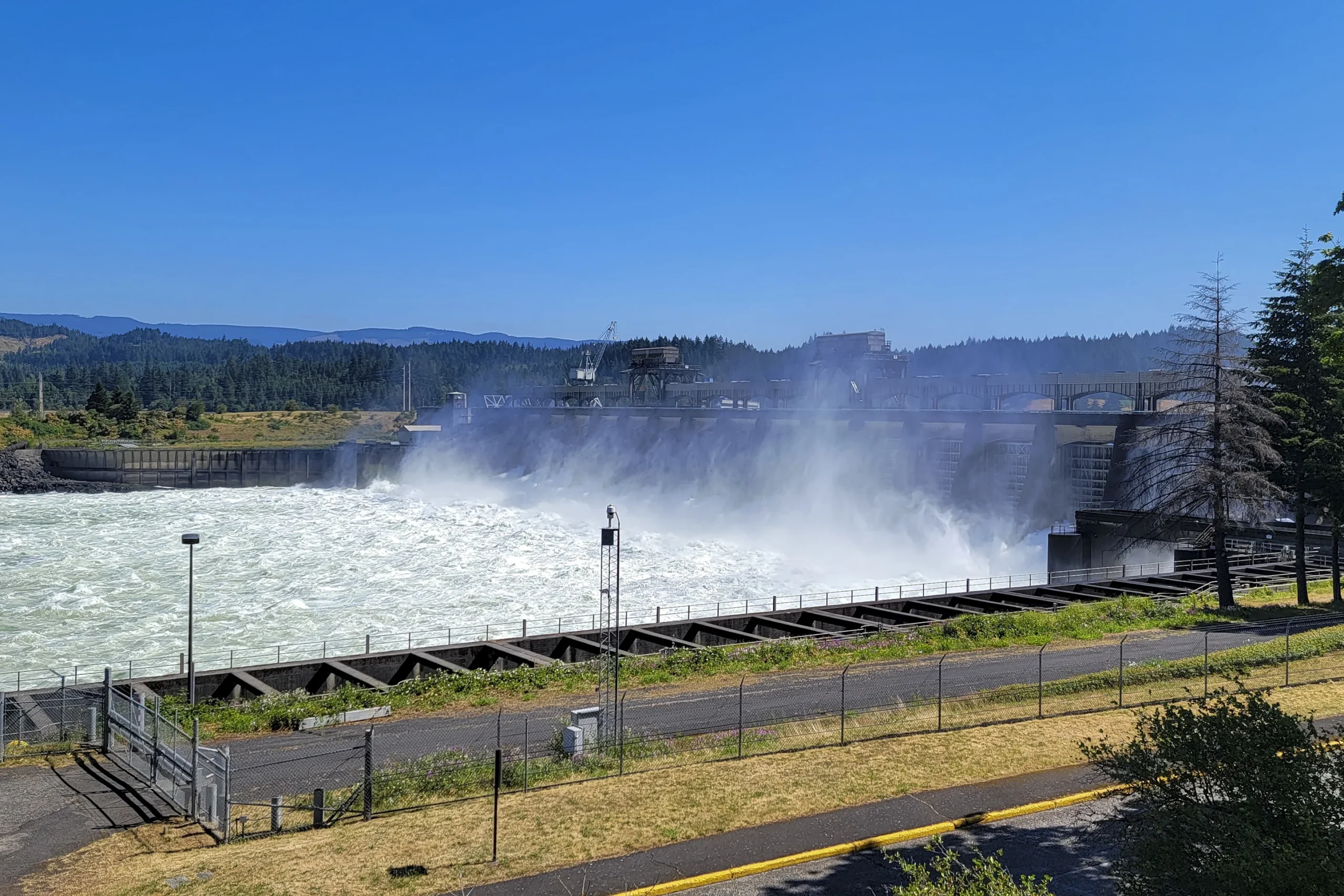

Bonneville Lock and Dam sits on the Columbia River about forty miles east of Portland, and the Bradford Island Visitor Center on the Oregon side is free, open daily, and has underwater windows into a fish ladder.
That last part is the reason to stop. You walk downstairs, sit on a bench in a dim room, and watch salmon, steelhead, shad, and lamprey climb past a pane of glass on their way upriver. It’s a fifteen-minute detour off I-84 that a lot of people drive past without knowing it’s there.
We spent about half an hour here between two waterfall hikes, and it was the most surprising stop of the day.
The Basics
- Where: Bradford Island Visitor Center, Exit 40 off I-84, Cascade Locks, Oregon
- Fee: None. Admission is free.
- Hours: 9 a.m. to 5 p.m. daily, closed Thanksgiving Day and December 24 through New Year’s Day
- Operated by: the US Army Corps of Engineers, Portland District
- Also on the Washington side: a second visitor complex
- Navigation Lock visitor center: seasonal — the Friday of Memorial Day weekend through Labor Day, 1 p.m. to 4 p.m.
- Directions: I-84 exit 40, about four miles west of Cascade Locks. At the flag pole intersection, bear right.
- What’s here: fish ladder viewing above and below the waterline, interpretive displays, views of the spillway and powerhouse
- Time needed: 30 to 60 minutes
- Tours: offered intermittently as staffing allows
Security screening applies — this is federal infrastructure, and vehicles may be inspected on the way in.
The Fish Ladder Is the Whole Point
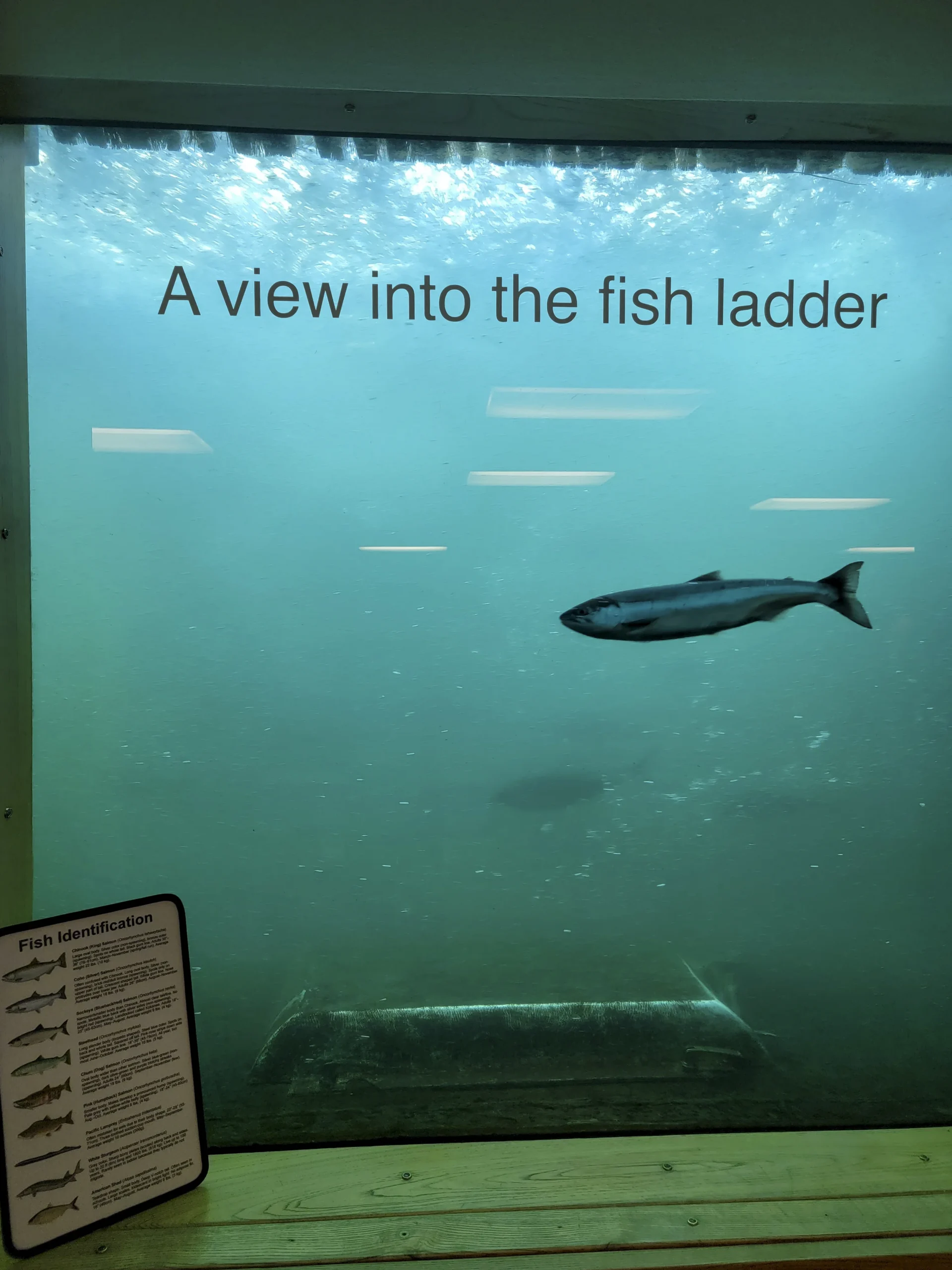
Fish ladders were built into Bonneville in 1937, when salmon and sturgeon runs on the Columbia were already declining. They work like a staircase of pools — fish either jump the low walls between them or swim through openings in the walls, climbing the height of the dam a few feet at a time.
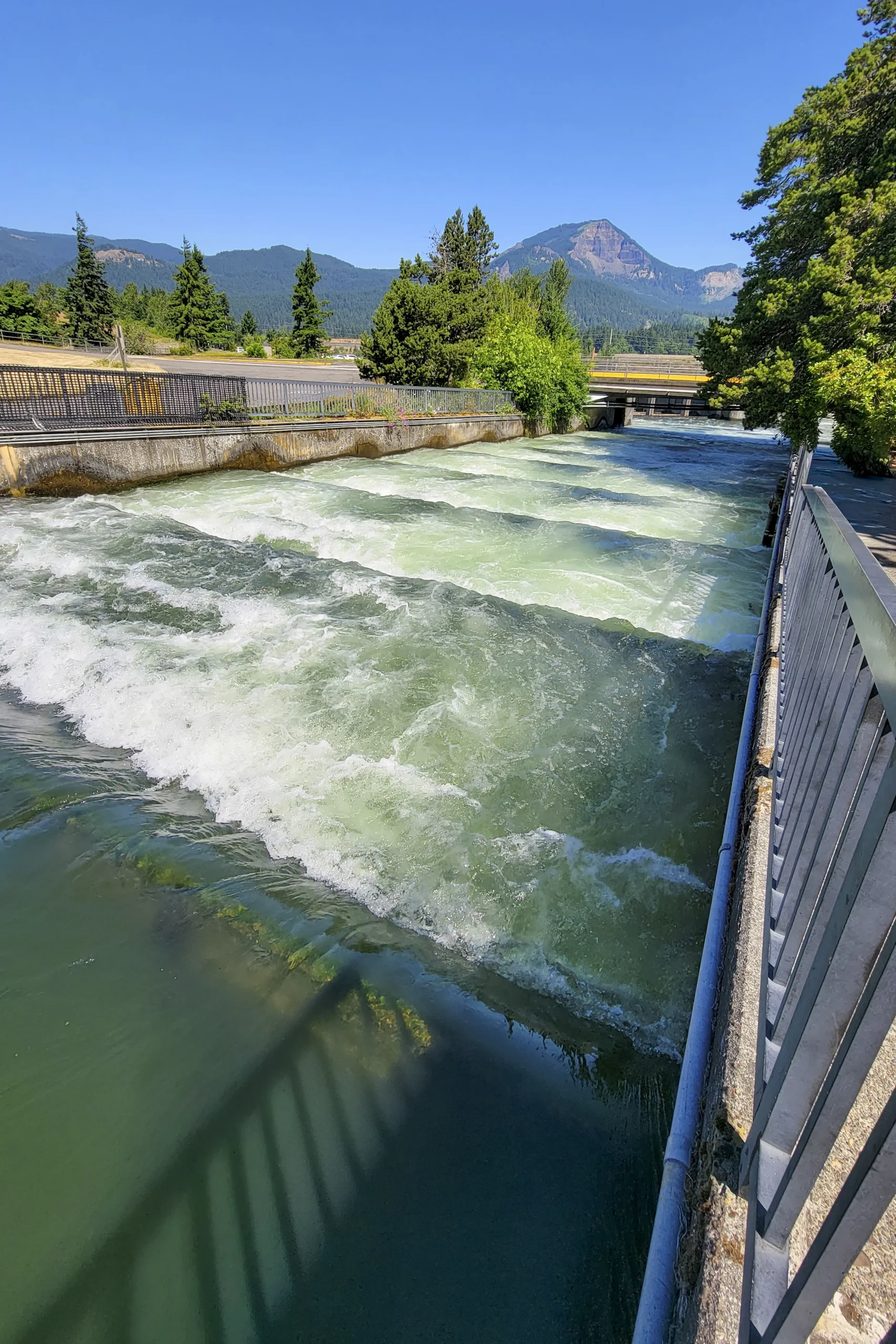
From above it reads as a long concrete flume with water stepping down it. From the underwater window it reads as an aquarium with a current.
Sit down and wait. Fish arrive in surges rather than a steady stream, and two minutes of nothing is often followed by a dozen going past at once.
When to Go to Bonneville Dam, According to the Corps
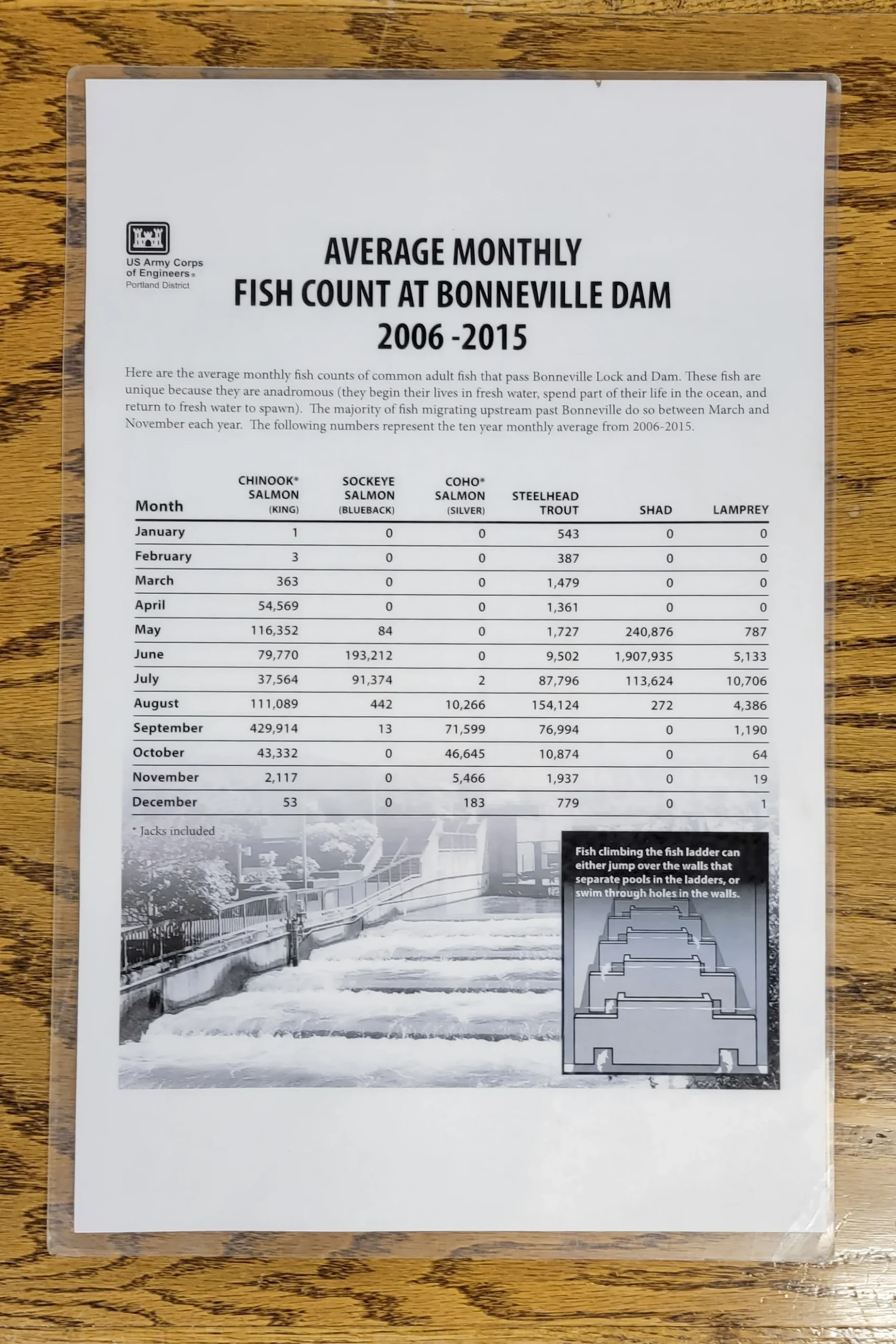
The visitor center posts a board with ten-year average monthly fish counts, 2006 to 2015, and it answers “when should I come” better than any description could.
The peaks:
| Species | Peak month | Ten-year monthly average |
|---|---|---|
| American shad | June | 1,907,935 |
| Chinook salmon | September | 429,914 |
| Sockeye salmon | June | 193,212 |
| Steelhead | August | 154,124 |
| Coho salmon | September | 71,599 |
| Pacific lamprey | July | 10,706 |
Nearly two million shad through one fish ladder in a single month. That figure is hard to hold in your head standing in front of the window.
A few things the board makes obvious:
- June and September are the two big months, for completely different reasons — shad and sockeye in June, chinook and coho in September.
- August is the steelhead month, at more than 150,000.
- December through March is nearly empty except for a trickle of steelhead.
- Most fish move upstream between March and November.
We came on July 4, which the board puts in the middle: past the shad surge, two months early for chinook, but the best month of the year for lamprey and a strong one for steelhead and sockeye.
The Lamprey Are the Ones to Look For
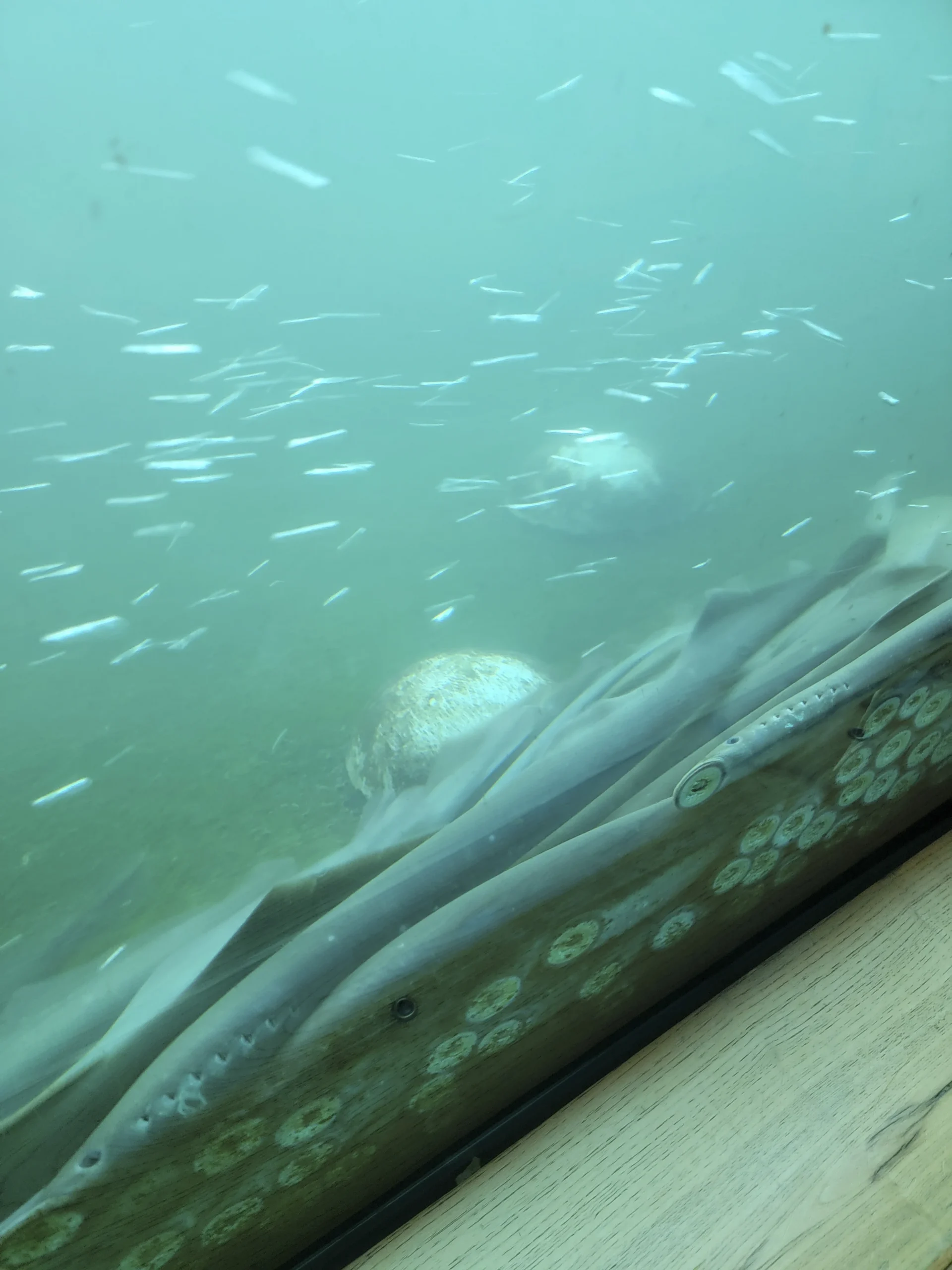
Pacific lamprey were stuck to the viewing glass, mouths fixed to the pane, bodies trailing in the current. It is not what you expect to see at a dam and it’s the image from the day I keep coming back to.
They matter more than the salmon do, in a way, because they’re in far worse trouble.
The fish ladders don’t really work for them. Ladders were engineered for salmon, which swim and leap. Lamprey climb — they attach with their mouths, release, surge forward, and attach again. Square corners and high-velocity flow that a chinook powers through will stop a lamprey.
The numbers are grim:
- Before the 1970s, more than 250,000 lamprey a year were counted at Bonneville.
- Within thirty years that had fallen to about 52,000.
- By the 1990s and 2000s they were near local extinction in parts of the basin.
Pacific lamprey are culturally important to the tribes of the Columbia River Basin, who harvested them for their rich, fatty meat and served them alongside salmon at feasts. In recent decades the tribes have been the species’ primary advocates, pushing for restoration when almost nobody else was paying attention.
Their counts are also the least reliable on the board. Lamprey can pass a dam, drop back downstream, and pass again, so a count isn’t a clean tally of individuals the way it roughly is for salmon.
The New Deal Is Still Standing Here
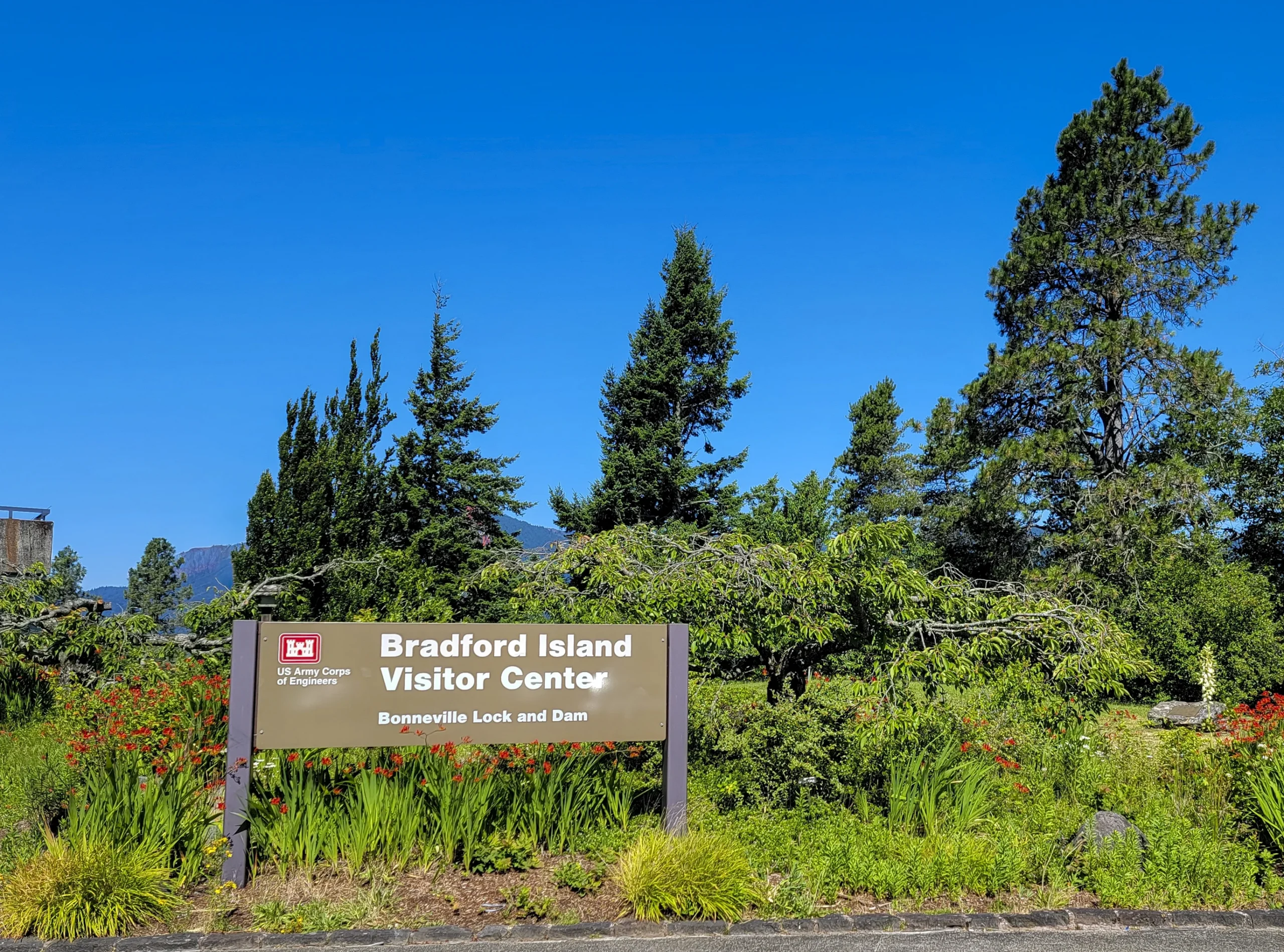
Bonneville was the first federal lock and dam on the Columbia and Snake rivers. The first powerhouse, the spillway, and the original navigation lock were finished in 1938. A second powerhouse followed in 1982 and a larger lock in 1993.
It generates enough electricity for roughly 900,000 homes — about a city the size of Portland.
Portions of the project were declared a National Historic Landmark in 1987, and the citation is broader than you’d expect for a dam: the Colonial-Revival architecture of the administration building and auditorium, the engineering design, the lock’s role in transportation, the entrance landscaping, and its significance as a major government undertaking to provide jobs during the Great Depression.
Roosevelt dedicated it the same day as Timberline Lodge
Here’s the detail that connects this stop to the rest of a Gorge and Mount Hood day.
On September 28, 1937, Franklin and Eleanor Roosevelt came to Oregon and dedicated two federal projects: Bonneville Dam and Timberline Lodge. FDR spoke to a crowd of about 6,000 at the dam, which wasn’t quite finished.
They were built by two different New Deal agencies. Bonneville Dam was a Public Works Administration project — big infrastructure, contracted out. Timberline was a Works Progress Administration project — direct employment, craftspeople making things by hand. Same president, same day, two different theories of how to put a country back to work, forty miles apart.
Drive the Gorge and then the Mount Hood Byway and you visit both in an afternoon without necessarily realizing they’re twins.
Some sources date the dam speech to September 29 rather than the 28th. The visit was the same trip either way.
And the name is an Oregon Trail name
The dam is named for Army Captain Benjamin Bonneville, who led an exploration into the Oregon Country in the 1830s and charted extensive sections of what became the Oregon Trail.
Which closes a loop across a single day’s driving: the Trail is carved into the relief panels inside Timberline Lodge, it crossed the Cascades at Barlow Pass on the Mount Hood Byway, and the man who mapped part of it has his name on this dam.
The Navigation Lock
The lock is the other half of the name, and it’s easy to overlook next to the fish.
It lifts boats around the dam so that barges, tugs, and pleasure craft can keep moving up and down the Columbia — the reason the river still works as a shipping corridor hundreds of miles inland.
The lock has its own seasonal visitor center, open from the Friday of Memorial Day weekend through Labor Day, 1 p.m. to 4 p.m., with exhibits on river commerce. You can watch the lock operate when a boat is going through — but there’s no schedule. Vessels come when they come.
Photography Notes
- The viewing windows are hard. Low light, thick glass, moving fish, and reflections from the room behind you. Press the lens close to the glass to kill reflections and push your ISO further than feels comfortable.
- Bring nothing that flashes. Flash off, always — it’s bad for the fish and it bounces straight back off the pane.
- The lamprey are the better subject than the salmon. They hold still on the glass, which solves your shutter speed problem, and almost nobody photographs them.
- The spillway wants a fast shutter to hold texture in the whitewater, or a slow one on a tripod for the opposite effect.
- The fish count board is worth a frame of its own. Legible reference photos of interpretive signage are the most useful pictures you’ll take all day.
- Midday is fine here — you’re indoors for the good part.
Know Before You Go
- Free, and open 9 to 5 daily except Thanksgiving and the Christmas–New Year window.
- Expect security screening. It’s an active federal facility.
- June and September are the peak fish months. July is good for lamprey and steelhead.
- Sit at the window for ten minutes. Fish come in bursts; people who glance and leave see nothing.
- There’s a second visitor center on the Washington shore, reached separately — you can’t drive between them across the dam.
- The Bonneville Fish Hatchery is nearby on the Oregon side, with sturgeon viewing ponds, and it’s also free.
- Exit 40 also serves Wahclella Falls, so the two pair naturally.
Is It Worth It?
Yes, and it’s the best free half hour in the Columbia River Gorge.
You can stand at a window under the Columbia River and watch a salmon go by. That’s an unusual thing to be able to do, it costs nothing, it takes half an hour, and it’s fifteen minutes off the interstate between two waterfall trailheads.
The honest caveats are small. It’s an industrial site and it looks like one. The fish don’t perform on schedule. And if you come in February the ladder will be close to empty.
Go in June or September if the fish are what you’re after. Any month, sit down at the glass and give it ten minutes rather than two — and look for the lamprey stuck to the pane, because they’re the ones that need the attention.
There are a lot of other things to do in the Columbia River area, read about them in our Columbia River Gorge guide.
For current hours, tours, and daily fish counts, visit the US Army Corps of Engineers pages for Bonneville Lock and Dam and Columbia River fish counts.
0 Comments