

Rocky Brook Falls and Murhut Falls are two short waterfall hikes on the Hood Canal side of the Olympic Peninsula, about twelve miles apart on Highway 101 near Brinnon, Washington. Together they make a comfortable morning — a little over three miles of walking for two waterfalls of very different character.
Rocky Brook is a 200-foot-plus horsetail fan at the end of a 200-yard walk. Murhut is a two-tier, 130-foot (40 m) drop through old growth at the end of a 1.6-mile (2.6 km) round trip. Neither is hard. Both are worth the stop.
One critical update before you plan anything. The Rocky Brook Falls trail is currently closed for construction, and the closure is expected to run through summer 2026. Check its status before you drive out. Murhut is open and unaffected.
Neither of these is in Olympic National Park. Murhut sits in Olympic National Forest, and Rocky Brook is on private land the owner allows the public to cross. Different agencies, different rules, and in Rocky Brook’s case, no guarantee of permanent access.
The Two Hikes at a Glance
| Rocky Brook Falls | Murhut Falls | |
|---|---|---|
| Distance | About 0.2 miles (0.3 km) round trip | 1.6 miles (2.6 km) round trip |
| Elevation gain | Negligible | About 250–400 feet (76–120 m) |
| Height of falls | 200+ feet (60+ m), claimed 229 | 130 feet (40 m) in two tiers |
| Difficulty | Very easy — a walk, not a hike | Easy |
| Land | Private, public access permitted | Olympic National Forest |
| Pass | None | None required |
| Status | Closed for construction through summer 2026 | Open |
Rocky Brook Falls
Getting There
From Brinnon, drive north on Highway 101 and turn west onto Dosewallips Road. Go about 3 miles and park out of the way of traffic. The walk starts on the right, just after you cross the Rocky Brook bridge.
There’s no formal parking lot — just roadside space — which is part of why the access situation matters.
The Access Situation

Read the sign at the trailhead. It’s genuinely one of the better interpretive signs you’ll find at a small trailhead, and it also spells out the boundaries.
The Rocky Brook Fish Board tracks which species are in the creek and when — pink, chinook, coho (wild and hatchery), chum, and sockeye salmon, plus steelhead, rainbow and cutthroat trout, and sculpin — with sliding markers for observed versus expected presence through the year. Notes on the board explain that pinks only spawn in odd-numbered years, that chinook prefer the larger Dosewallips nearby, and that the hatchery coho most likely come from Quilcene.
The boundaries are equally clear:
- The area below the bridge is private and closed to the public.
- Fish may be observed from the trail above the bridge to the falls.
- There’s a private residence adjacent, marked no trespassing.
The falls area sits on land the owner permits people to walk across, and part of the site is tied to a hydroelectric diversion. Access has never been formally guaranteed — it continues because people behave. Stay on the trail, don’t cross into the private sections, and pack out what you bring.
The Walk

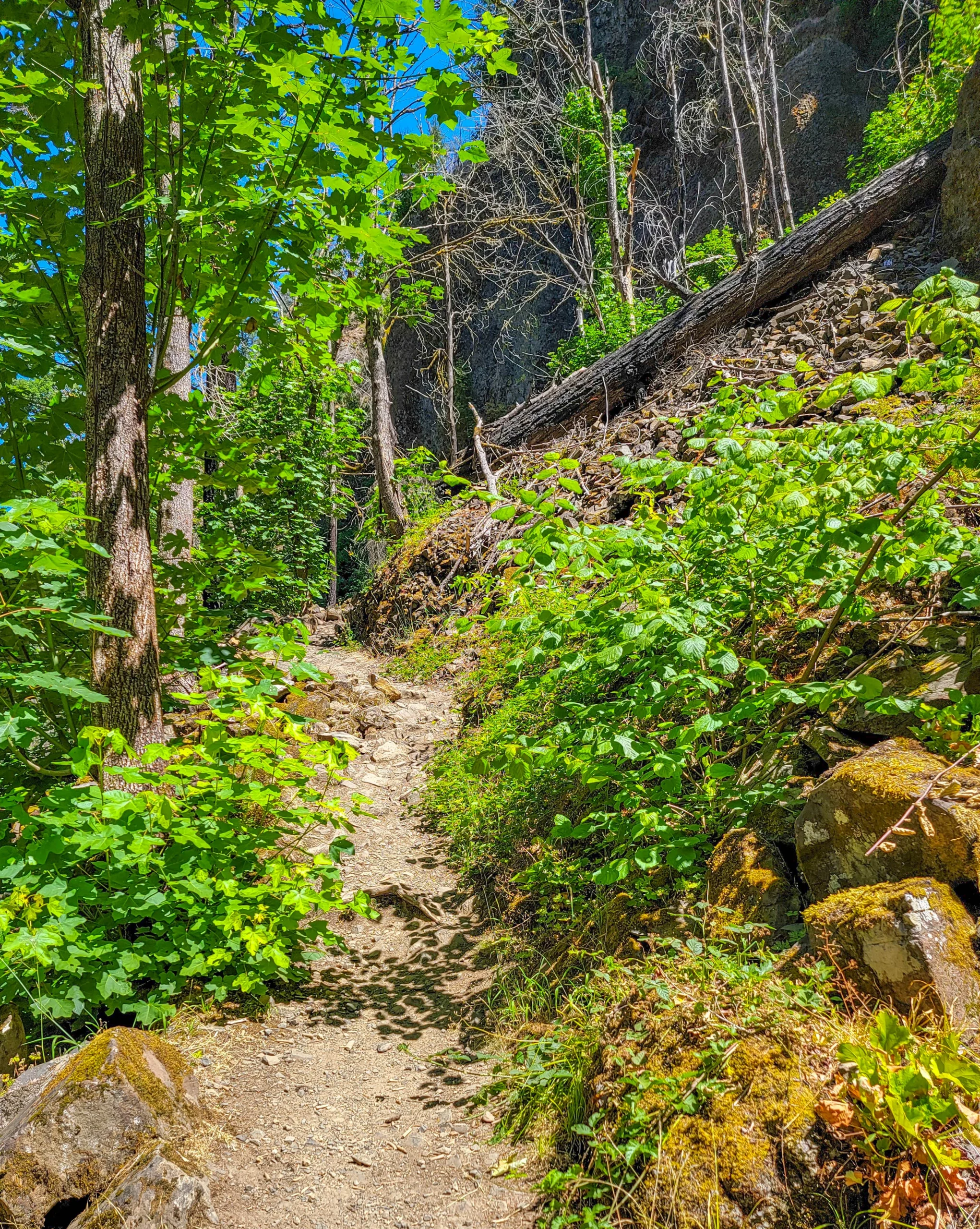
Calling this a hike oversells it. It’s about 200 yards along the creek, nearly flat, on a rough path through moss-heavy forest.

The forest here is dense, wet, and green in a way that photographs badly in sun and beautifully in cloud. Big-leaf maple and conifer, with moss on every horizontal surface.
Then the trees open and the falls are just there.
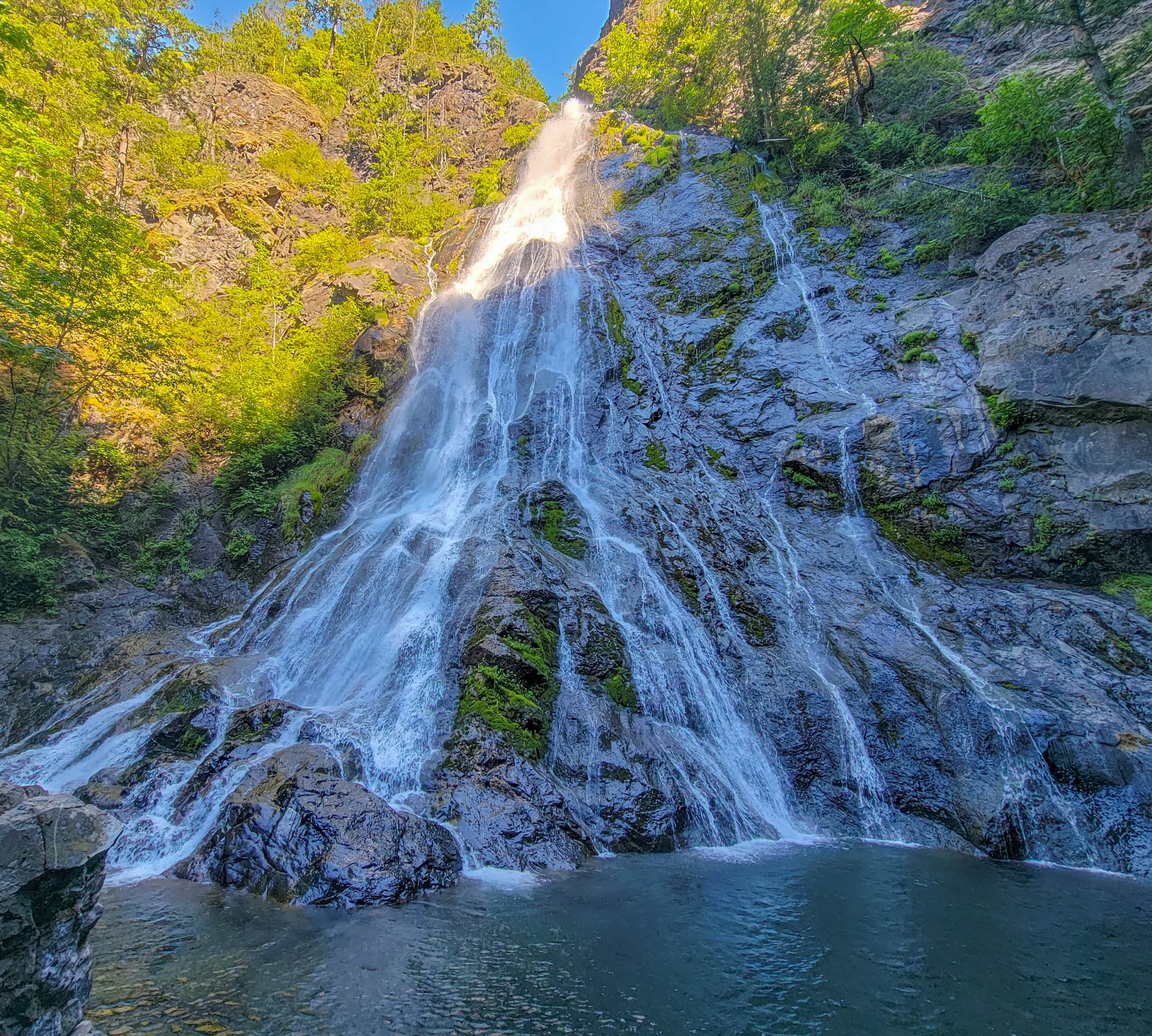
Rocky Brook Falls fans out across a broad bedrock face, splitting into dozens of threads as it drops from a hanging valley above. The commonly cited height is 229 feet, though most descriptions say “more than 200.” Either way it’s tall, and the fan shape means it reads as much wider than a typical plunge.
There’s a large gravel bar and a plunge pool at the base, and on a warm day people wade. The spray reaches well back from the base when flow is up, so expect to get damp if you walk in close.
Murhut Falls
Getting There
From Hoodsport, drive north about 22 miles on Highway 101 to the Duckabush Recreation Area. Turn west onto Forest Service Road 2510 and follow it 6.2 miles, then turn right onto FS Road 2530 for 1.3 miles to the trailhead.
The forest roads are gravel and rough in places but manageable in a passenger car in dry conditions. No pass is required — unusual for a Forest Service trailhead and worth knowing.
The Trail

Murhut Falls Trail #828 runs 0.8 miles (1.3 km) each way on an old roadbed, which is why it’s wide, well graded, and easy underfoot. It climbs gently through second growth into old forest.
The stumps are the giveaway. Enormous cedar stumps with springboard notches cut into them stand beside the trail — evidence of hand-logging from an era when fallers stood on planks wedged into the trunk to get above the flared base.

The trail is genuinely kid-friendly — no exposure, no scrambling, no creek crossings. About 250 to 400 feet of gain depending on whose measurement you use, spread over less than a mile.
The Falls

Murhut Falls drops in two tiers totaling about 130 feet (40 m) — an upper fall of more than 100 feet and a lower one of roughly 30, with a pool between them and old-growth conifer standing right up against the canyon walls.
It’s the more photogenic of the two. Rocky Brook is bigger and more dramatic; Murhut is better composed, framed by trees, with the two tiers stacked in a single view.
Downed logs cross the lower pool at odd angles, which is either a compositional gift or a nuisance depending on your taste.

Doing Both in a Morning
They’re about twelve miles apart on Highway 101, both on the Hood Canal side, and together they came to a little over three miles of walking for us. We did them back to back on a June morning and were finished before lunch.
Order matters slightly. Rocky Brook faces roughly east and catches morning light on the rock face — which is harsh. Murhut sits deep in forest and holds even light most of the day. If you’re shooting, do Murhut first thing and Rocky Brook later, or go on an overcast day and stop worrying about it.
Photography Notes
- Overcast is the right condition for both. Rocky Brook in direct sun is a blown-out white sheet against black rock.
- Bring a tripod and a polarizer. Both falls want a slow shutter, and the polarizer cuts glare off wet stone and leaves.
- Rocky Brook needs a wide lens — the fan is broad, and you’re standing close to it.
- Murhut wants a vertical frame to get both tiers with the trees.
- Expect spray at Rocky Brook. Keep a cloth in your pocket and check the front element between frames.
- Video works well at Murhut — the two-tier structure and the sound carry better in motion than in a still.
Know Before You Go
- Check Rocky Brook’s status first. Closed for construction, expected through summer 2026.
- Rocky Brook is private land. Access is a courtesy, not a right. Stay on the trail, stay above the bridge, take nothing.
- No passes needed at either, as of now.
- Neither is in the national park — Murhut is national forest, Rocky Brook is private.
- Roadside parking only at Rocky Brook. Park clear of traffic on a narrow road.
- Spring runoff is the best flow. Both drop noticeably by late summer.
- Watch for salmon in fall at Rocky Brook, from the trail above the bridge only. The fish board tells you what to expect and when.
Is It Worth It?
Yes to both, with the caveat that these are stops rather than destinations.
Nobody drives to the Olympic Peninsula specifically for Rocky Brook or Murhut. But if you’re on Highway 101 heading toward the park — and most people driving the peninsula pass within a few miles of both — you can add two waterfalls to your day for about three miles of easy walking and less than two hours total.
Murhut is the better hike. Rocky Brook is the bigger waterfall. If you only have time for one and Rocky Brook is open, take Rocky Brook for the sheer scale of it. If it’s closed, or if you’d rather walk in old growth than stand beside a road, take Murhut.
For other ideas and things to do on the Olympic Peninsula, check out our Olympic Peninsula Guide.
For current trail conditions, check the Olympic National Forest page for Murhut Falls Trail #828 and the Washington Trails Association listing for Rocky Brook Falls.

0 Comments